
Fill every cell so each row and column uses the full number range exactly once.
Futoshiki Online
Play Futoshiki online by filling each row and column with unique numbers while following every greater-than and less-than clue. Start with a 4×4 grid, then try larger 6×6 and 8×8 puzzles.
My Best-
Latest Result-
Round Timer0s
This board is 4×4.Goal Rules Demo The timer starts only after you click Start game.
Start Futoshiki
Choose a board size, review the row, column, and inequality rules, then start the timer when you are ready.
All visible < and > signs must be true after both neighboring cells are filled.
In the demo, 1 < 3 and 4 > 2 are both valid relationships.
My Futoshiki Practice Record
Complete a grid to start tracking
Your completed grids, average time, best time, and latest result will appear here.
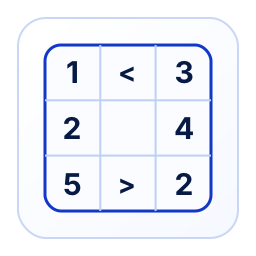 Futoshiki Daily ChallengePlay today's shared challenge.
 Bulls and CowsDeduce the hidden number from A/B clues.
 Countdown NumbersCombine numbers and operations to hit the target.
How to Play Futoshiki
- Fill the grid with numbers
Each Futoshiki puzzle uses an N×N grid. Fill every empty cell with a number from 1 to N.
- Avoid repeats in rows and columns
Each row and each column must contain every number exactly once, so no number can repeat in the same row or column.
- Follow every inequality clue
Greater-than and less-than signs between neighboring cells must be true. If one cell is marked greater than another, its number must be larger.
- Narrow candidates step by step
Use given numbers, row and column restrictions, and inequality clues to remove impossible candidates until the full grid is solved.
Online Futoshiki: Grid Logic and Inequality Practice
Futoshiki is a grid logic puzzle that combines number placement with greater-than and less-than clues. Fill the grid so every row, column, and inequality relationship is valid.
This online version is designed for short practice sessions. Start with a 4×4 Futoshiki puzzle, then move to 6×6 or 8×8 grids when you want longer reasoning chains.
Reasoning Tips
Good Futoshiki solving is about narrowing candidates before filling cells. Start from the most constrained rows, columns, and inequality chains, then place numbers only when the clues leave a clear choice.
Start with constrained rows and columns
Rows or columns with more givens usually remove more candidates early.
Use inequalities as range clues
The greater side cannot be too small, and the smaller side cannot be too large.
Avoid row and column repeats
Each row and column must contain 1 to N exactly once.
Do not fill the grid too early
When a cell still has many candidates, switch to a more constrained cell first.
FAQ
What is Futoshiki?
Futoshiki is a grid logic puzzle where you fill each row and column with unique numbers while following greater-than and less-than clues between neighboring cells.
How is Futoshiki different from Sudoku?
Both puzzles use non-repeating rows and columns, but Futoshiki adds inequality clues. These greater-than and less-than signs create extra relationships between neighboring cells.
What do the inequality signs mean?
A greater-than sign means the number on the greater side must be larger. A less-than sign means the number on the smaller side must be lower. Every inequality must be true when the grid is complete.
Why do some cells have no inequality?
Not every neighboring pair needs a clue. When there is no inequality sign, use row and column uniqueness to narrow the possible numbers.
What changes between 4×4, 6×6, and 8×8 Futoshiki?
Larger grids have more numbers, wider candidate ranges, and longer reasoning chains. Start with 4×4 if you are new, then move to 6×6 or 8×8 for a harder puzzle.
What should I do when stuck?
Look for the cell with the fewest candidates, then recheck its row, column, and nearby inequality clues. Avoid guessing until the clues remove more possibilities.
Related Futoshiki Guides
How to Play Futoshiki
Learn row and column uniqueness, inequality clues, and candidate removal.

How Daily Challenges Work
Understand shared daily puzzles, result submission, and daily comparisons.
How to Use the Daily Archive
Review past Futoshiki puzzles, grid sizes, and archived records.
Futoshiki Daily Archive
Browse historical Futoshiki daily puzzles, results, and completion records.